3. Symmetries and symmetry subspaces
Goal. Compute the Rayleigh–Bénard onset mode in the subspace of solutions symmetric about
mid-depth, with half the unknowns, and see what the subspace hides.
Expected. At \((Ra_c, k_c) = (1707.762, 3.1163)\) (Reid & Harris 1958; Chandrasekhar 1961) the
leading growth rate is zero within the rounding of the published values; the subspace gives the same eigenvalue to
rounding with half the unknowns. The complementary class decays.
Time: a few seconds of CPU.
Script: t03_symmetries.py · Tests behind it:
tests/evp/test_rayleigh_benard.py.
The idea
A symmetry is declared, never guessed. You give a group (here the reflection \(z \to -z\)) and the parity of each field; Conatus then
checks that every equation is equivariant and refuses otherwise, naming the offending term;
builds bases of the invariant subspace (even or odd Chebyshev polynomials, cosines or sines) and drops the boundary conditions that became mirror images of each other;
solves only there, on CPU or GPU.
For a vector field you declare only the “scalar” parity: under a reflection the component along the
reflected direction changes sign, the others do not (du=ODD means \(u_x\) odd, \(u_z\) even).
The problem
The Boussinesq equations of 2. A first initial-value problem: Rayleigh–Bénard 2D, CPU then GPU, written as on paper, on one wavelength \(2\pi/k_c\), and their linearization about the conduction state \(T_0 = -z\):
RA_C, K_C = 1707.762, 3.1163                  # Reid & Harris (1958)
box = cn.Box(x=cn.periodic(2 * np.pi / K_C), z=cn.walls(-0.5, 0.5))   # one wavelength at k_c
m = cn.Model(box, name="Boussinesq RB", Ra=RA_C, Pr=1)
u, p, T = m.velocity("u"), m.pressure("p"), m.scalar("T")
m.equations("""
    momentum:   dt(u) + grad(p) - Pr*lap(u) = Pr*Ra*T*ez - u·grad(u)
    continuity: div(u) = 0
    heat:       dt(T) - lap(T) = -u·grad(T)
""")
m.at("bottom", u=0, T=+0.5)                   # rigid plates, fixed temperatures
m.at("top", u=0, T=-0.5)
onset_evp = m.linearize(about={u: 0, T: lambda z: -z})   # conduction state T0 = -z
The full space first
discretize(32, k=K_C) takes 32 modes across the layer and the smallest Fourier size that holds
\(k_c\); the eigenvalues of that wavenumber come with their residuals:
plan = onset_evp.discretize(32, k=K_C)        # N = 32 across the layer, the Fourier size holds k_c
group = onset_evp.group(plan, K_C)
t0 = time.perf_counter()
res = eigenvalues(plan, group)
wall_full = time.perf_counter() - t0
i = int(res.values.real.argmax())
sf, nf = res.values[i], plan.matrices(group).L.shape[0]
print(f" full space: leading sigma = {sf.real:+.4e}   n = {nf:3d}   QZ {1e3 * wall_full:5.1f} ms   "
      f"residual {res.residuals[i]:.1e}")
Two symmetry classes
This step uses the expert layer, because the native layer has no symmetry= option yet: the
subspace is declared on the compiled perturbation problem, and the boundary unknowns that the native
layer created (tau_u1, tau_T1, …, listed by m.explain()) need their parities written out
like the physical fields.
evp, ncc, comp = onset_evp.compile({"x": 4, "z": 32})   # the compiled problem (expert objects)
print("unknowns of the perturbation problem:", ", ".join(v.name for v in evp.variables))
Rz = Reflection(comp.coordsys["z"], about=0)  # z -> -z about mid-depth
# Perturbation unknowns carry the prefix d. Only the "scalar" parity is declared for a vector:
# du=ODD means u_x odd and u_z even (the component along z flips sign under the reflection).
# The boundary unknowns tau_* were created by the native layer (listed by m.explain()); their
# parities follow from the walls they enforce and are declared too.
onset = SymmetrySubspace(Rz, du=ODD, dT=EVEN, dp=ODD, T0=ODD,         # w, T even: the onset roll
                         dtau_u1=EVEN, dtau_u2=ODD, dtau_T1=ODD, dtau_T2=EVEN, dtau_p=ODD)
other = SymmetrySubspace(Rz, du=EVEN, dT=ODD, dp=EVEN, T0=ODD,       # the complementary class
                         dtau_u1=ODD, dtau_u2=EVEN, dtau_T1=EVEN, dtau_T2=ODD, dtau_p=EVEN)
print(onset.explain())
Solve in each class
out = {}
for label, sym in (("onset class", onset), ("other class", other)):
    sub = linearize(comp.problem, evp.base, evp.eigenvalue, symmetry=sym)
    splan = discretize(sub, ncc=ncc)
    g = next(g for g in splan.groups if g[0].k > 0)
    t0 = time.perf_counter()
    r = eigenvalues(splan, g)
    wall = time.perf_counter() - t0
    j = int(r.values.real.argmax())
    out[label] = (r.values[j], splan.matrices(g).L.shape[0])
    print(f"{label:>11}: leading sigma = {r.values[j].real:+.4e}   n = {out[label][1]:3d}   "
          f"QZ {1e3 * wall:5.1f} ms   residual {r.residuals[j]:.1e}")
    if sym is onset:
        print(sub.symmetry_report())          # mirrored conditions dropped, what the subspace hides
linearize rebuilds the perturbation problem with symmetry=; everything downstream (plan,
eigenvalues, residuals) is unchanged. symmetry_report() lists the parity of every component, the equivariance of every
equation and the boundary conditions dropped as mirror images, and always warns that the subspace
hides symmetry-breaking instabilities. Here the other class is the check: its leading mode decays
strongly, so the onset mode found in the symmetric class is the leading mode of the
full problem. A dense QZ costs \(O(n^3)\); halving \(n\) saves 2–8× depending on the size.
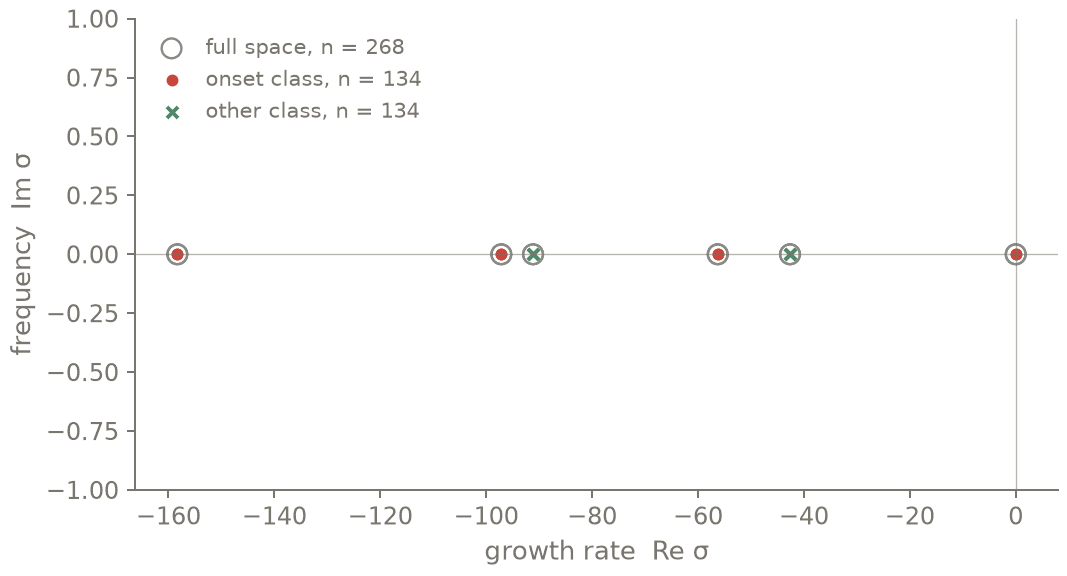
Every eigenvalue of the full space (rings) is found in exactly one of the two symmetry classes, each solved with half the unknowns. The neutral mode at the onset point belongs to the onset class.
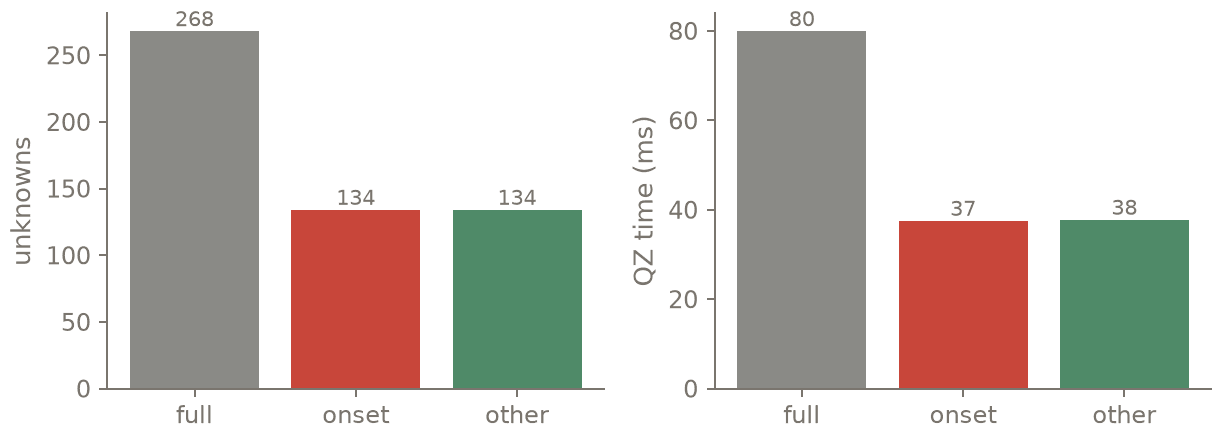
Size and cost of each eigenproblem as measured in this run. Halving the unknowns makes the dense QZ solve several times cheaper (it scales as n³).
A wrong declaration is refused
wrong = SymmetrySubspace(Rz, du=EVEN, dT=EVEN, dp=EVEN, T0=ODD,       # T with the parity of w:
                         dtau_u1=ODD, dtau_u2=EVEN, dtau_T1=EVEN, dtau_T2=ODD, dtau_p=EVEN)
try:                                                                   # not equivariant
    linearize(comp.problem, evp.base, evp.eigenvalue, symmetry=wrong)
except SymmetryBreakingError as e:
    print(f"refused: {e}")
Check
At Reid & Harris’ \((Ra_c, k_c)\) the leading growth rate is \(1.7\times10^{-6}\) (zero within the rounding of the published \(Ra_c\) and \(k_c\)), the onset class gives the same eigenvalue to rounding with half the unknowns, and the other class decays.
(so, no), (sa, _) = out["onset class"], out["other class"]
assert abs(sf) < 1e-4, sf                     # neutral at (Ra_c, k_c) to the published digits
assert abs(so - sf) < 1e-10                   # the onset class carries the leading mode ...
assert sa.real < -1                           # ... the other class decays at onset
assert no <= 0.55 * nf                        # with about half the unknowns
print(f"OK: neutral mode at Reid & Harris' (Ra_c, k_c) in the onset class, n = {no} vs {nf}")
Output (as executed)
# t03_symmetries: PASS (exit 0) in 3.5 s | 2026-10-20 | script sha256 06b9053531b4dd1f
 full space: leading sigma = +1.6955e-06   n = 268   QZ 130.5 ms   residual 5.3e-17
unknowns of the perturbation problem: du, dp, dT, dtau_u1, dtau_u2, dtau_T1, dtau_T2, dtau_p
Symmetry subspace: Z2 (order 2)
  generator: Reflection(z -> -z): reflection of z about z = 0; vector components along it change sign, others do not
  T0         odd under Reflection(z -> -z)
  dT         even under Reflection(z -> -z)
  dp         odd under Reflection(z -> -z)
  dtau_T1    odd under Reflection(z -> -z)
  dtau_T2    even under Reflection(z -> -z)
  dtau_p     odd under Reflection(z -> -z)
  dtau_u1    even under Reflection(z -> -z)
  dtau_u2    odd under Reflection(z -> -z)
  du         odd under Reflection(z -> -z)
  expected reduction: up to x2 per reflection, x m0 per m0-fold rotation (adapted bases: parity blocks, kept azimuthal classes, docs/site/tutorials/03_symmetries.md)
  WARNING: computing in the invariant subspace hides symmetry-breaking instabilities; a symmetric solution is not declared stable before symmetry_breaking_check().
onset class: leading sigma = +1.6955e-06   n = 134   QZ  67.2 ms   residual 9.8e-18
Symmetry subspace: Z2 (order 2)
  generator: Reflection(z -> -z): reflection of z about z = 0; vector components along it change sign, others do not
  T0         odd under Reflection(z -> -z)
  dT         even under Reflection(z -> -z)
  dp         odd under Reflection(z -> -z)
  dtau_T1    odd under Reflection(z -> -z)
  dtau_T2    even under Reflection(z -> -z)
  dtau_p     odd under Reflection(z -> -z)
  dtau_u1    even under Reflection(z -> -z)
  dtau_u2    odd under Reflection(z -> -z)
  du         odd under Reflection(z -> -z)
  expected reduction: up to x2 per reflection, x m0 per m0-fold rotation (adapted bases: parity blocks, kept azimuthal classes, docs/site/tutorials/03_symmetries.md)
  WARNING: computing in the invariant subspace hides symmetry-breaking instabilities; a symmetric solution is not declared stable before symmetry_breaking_check().
Equivariance (parity of each equation):
  [0] odd under Reflection(z -> -z)
  [1] odd under Reflection(z -> -z)
  [2] even under Reflection(z -> -z)
  [3] odd under Reflection(z -> -z)
  [4] even under Reflection(z -> -z)
  [5] odd under Reflection(z -> -z)
  [6] even under Reflection(z -> -z)
  [7] zero under Reflection(z -> -z)
Under Reflection(z -> -z):
  du         odd (du_x odd, du_z even)
  dp         odd
  dT         even
  dtau_u1    even (dtau_u1_x even, dtau_u1_z odd)
  dtau_u2    odd (dtau_u2_x odd, dtau_u2_z even)
  dtau_T1    odd -> constant along the mirror direction and odd: vanishes identically
  dtau_T2    even
  dtau_p     odd -> constant along the mirror direction and odd: vanishes identically
  BC [3] and [5] are mirror images under Reflection(z -> -z): redundant in the subspace, one of them (and its tau) is dropped at discretization
  BC [4] and [6] are mirror images under Reflection(z -> -z): redundant in the subspace, one of them (and its tau) is dropped at discretization
other class: leading sigma = -4.2627e+01   n = 134   QZ  66.7 ms   residual 1.5e-16
refused: equation 's*du - Pr*lap(du) + lift(dtau_u1, z, -1) + grad(dp) + lift(dtau_u2, z, -2) - Ra*dT*Pr*ez = 0' is not equivariant under Reflection(z -> -z): term '-Ra*dT*Pr*ez' is odd but 's*du' is even. The term breaks the declared symmetry (fix the parities or drop the symmetry).
  docs:  guide/errors#symmetrybreakingerror  (python -m conatus docs guide/errors)
OK: neutral mode at Reid & Harris' (Ra_c, k_c) in the onset class, n = 134 vs 268
Going further
Time-stepping in a subspace:
rayleigh_benard_2d(..., symmetric=True)intests/ivp/ivp_cases.py(reflection \(x \to -x\), same trajectory as the full space to \(10^{-12}\) with half the unknowns); initial data outside the subspace is refused.Shift-reflect, m-fold rotations, equatorial parity:
ShiftReflect,AzimuthalMFold,EquatorialParity(see Bases and domains).Symmetric orbits of Kuramoto–Sivashinsky: 5. Invariant solutions: Kuramoto–Sivashinsky, L = 22.